
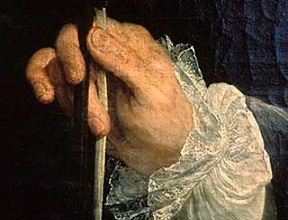
Very few details of the life of Jean de Sainte-Colombe are known to us. Yet he is one of the finest viol players of all time, and his contribution to the evolution of the viola da gamba and of its repertory was considerable. One may rest assured that, without him, the viol would not have become what it has: one of the flagship instruments of early music, endowed with an extraordinary repertory. Indeed, we owe to him the use of wire-wound strings (in place of plain gut) for the low strings, as well as the addition of the seventh string, which gives the instrument all its depth and that low, resonant, most characteristic colour.
Sainte-Colombe spent his life far from the splendours of the court, but his influence in the Parisian musical world was great: he regularly gave concerts at home, notably in the company of his two daughters, Françoise and Brigide, viol players too. He was likewise a renowned teacher who numbered among his pupils Pierre Méliton, Jean Desfontaines, Jean Rousseau and the great Marin Marais.
We also know that he frequented the luthier Nicolas Collichon, in the rue de la Harpe (in Paris), where Demachy and Dubuisson, other famous viol players, had lived. It was indeed Michel Collichon, Nicolas’s son, who made the first seven-string bass viol in 1683 (an instrument now displayed at the Musée de la Cité de la Musique in Paris).
Sainte-Colombe also knew how to surround himself with mystery: when he judged that Marais no longer needed him, he refused to continue teaching him, and Marais was then left with no other solution than to hide in the hut in which the master worked, to try to surprise his secrets!
Comet Musicke therefore invites you to follow in the footsteps of Monsieur de Sainte-Colombe in seventeenth-century Paris, when his music was in dialogue with that of his contemporaries.
Works by Monsieur de Sainte-Colombe and Sébastien Le Camus.
Performers
Francisco Mañalich – tenor & viola da gamba
Aude-Marie Piloz – viola da gamba