
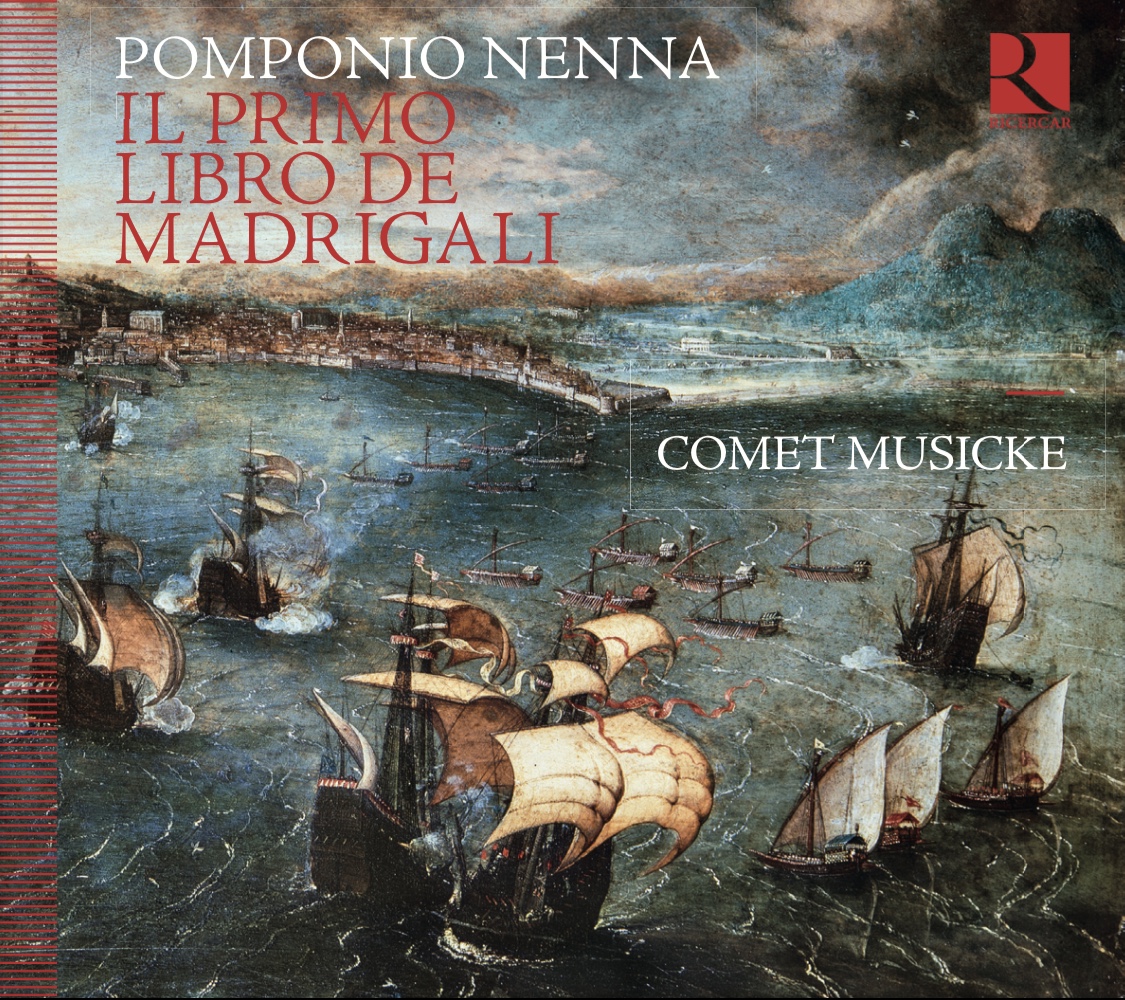
Recording programme: the complete First Book of Madrigals for Five Voices by Pomponio Nenna (1556 – 1608).
Pomponio Nenna was born in Bari in 1556. His family, of noble origin, was honoured with the title of “Knight of Cesare” by the Emperor Charles V at his coronation in Bologna in 1530.
After studying under Stefano Felis in his native city, Nenna settled in Naples, where he began his career as a composer in a stimulating climate of emulation. Thus Nenna and Carlo Gesualdo mutually influenced each other in the writing of their madrigals: treatment of the text, dissonances, chromatic modulations… This compositional experimentation was the prelude to what would a few years later be called the Seconda Pratica, an artistic movement that gave birth to the operatic genre at the end of the sixteenth century.
The link between Nenna and Gesualdo is not anecdotal, since in 1582 Nenna dedicated his Primo libro de madrigali a cinque voci to Fabrizio Carafa, Duke of Andria, who was later to perish, assassinated by Gesualdo in 1590 when the latter discovered the affair between the Duke and his own wife, Maria d’Avalos…
Carafa had appointed Nenna governor of Andria. Ten years later, the composer met Gesualdo in person when the latter entered his service in Naples. Gesualdo is said to have studied under Nenna in the early years of his service. Be that as it may, the intellectual and artistic relationship between the two composers was evidently most fruitful and had notable consequences for the genius of these two artists.
The First Book of Madrigals for Five Voices by Pomponio Nenna has until now never been recorded. The five-voice pieces of this collection are of great interest: the composer possessed a unique style, characterised by great refinement, a carefully wrought counterpoint blending “madrigalesque” gestures with more archaic procedures such as the faux-bourdon, as well as the vertical writing of the religious pieces typical of that period. This book must not be confused with the Primo libro de madrigali a quattro voci, written in 1613, a work which achieved greater fame largely thanks to the basso continuo line added later by the Italian guitarist Carlo Milanuzzi.
The recording project of the ensemble Comet Musicke seeks to rediscover the earliest traces of this forgotten composer, although he is without doubt a crucial link in the evolution of Italian vocal music, the music which a few years later gave birth to the most important genre in the history of music: opera.
The vocal music is complemented by a few instrumental pieces for organ adapted for the viol consort, written by composers from the region such as Giovanni Maria Trabaci and Giovanni di Macque.
Record reviews / press coverage:
* Special prize of the Deutschen Schallplattenkritik 2026!!! (German, Austrian and Swiss jury)
* 5 Diapasons! (French Review)
* 5 stars from the Rivista Musica (Italian Review)
* Il giornale della musica
* Online Merker (German website)
* Scherzo.es (Spanish website, “Excepcional” disc award of June 2026)
* Stretto.be (Belgian Dutch-language website)
Performers
Myriam Arbouz – soprano
Sarah Lefeuvre – soprano & recorders
Marie Favier – mezzo-soprano
Francisco Mañalich – tenor & viola da gamba
Aude-Marie Piloz – viola da gamba
Cyrille Métivier – cornett & vihuela de arco
Cyrille Lerouge – counter-tenor
Jan Jeroen Bredewold – bass
Daniela Maltrain – viola da gamba
Anne-Sophie Eiselé – viola da gamba