
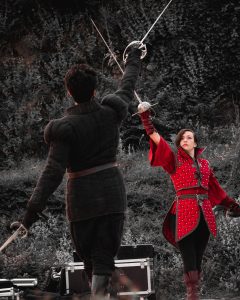
Clorinda, Ottavia: two tragic figures with strangely symmetrical stories. The first, a valiant warrior, dies at the hands of the very man who loves her. The second is condemned to exile by her unfaithful husband.
Two stories, that of ancient Greece as revered by Renaissance men, but also a medieval mythology revisited by Torquato Tasso (1544-1595), glorifying the Crusades. Il Combattimento di Tancredi e Clorinda by Claudio Monteverdi was performed in Venice in 1624; we know it from the version published in 1638 in the 8th book of warlike and amorous madrigals. L’incoronazione di Poppea, the last opera written by Monteverdi, was premiered in Venice at the Santi Giovanni e Paolo Theatre, shortly before his death. Two dense, short scenes that give the father of opera the opportunity to deploy multiple innovations uniting music and text in a single dramatic impulse, such as the use of repeated notes in Tancredi as an expression of rage.
Music by Dario Castello, Cipriano da Rore, Vincenzo Bonizzi and, of course, Claudio Monteverdi. Choreography by Mélodie Veillard and Lorenzo Bello.
Performers
Mélodie Mo & Lorenzo Bello – theatrical fencing & choreography
Francisco Mañalich – tenor (Testo) & viola da gamba
Myriam Arbouz – soprano (Clorinda & Ottavia)
Aude-Marie Piloz – viola da gamba
Camille Rancière – alto & voice (Tancredi)
Cyrille Métivier – cornett & violin
Aurélie Métivier – alto