
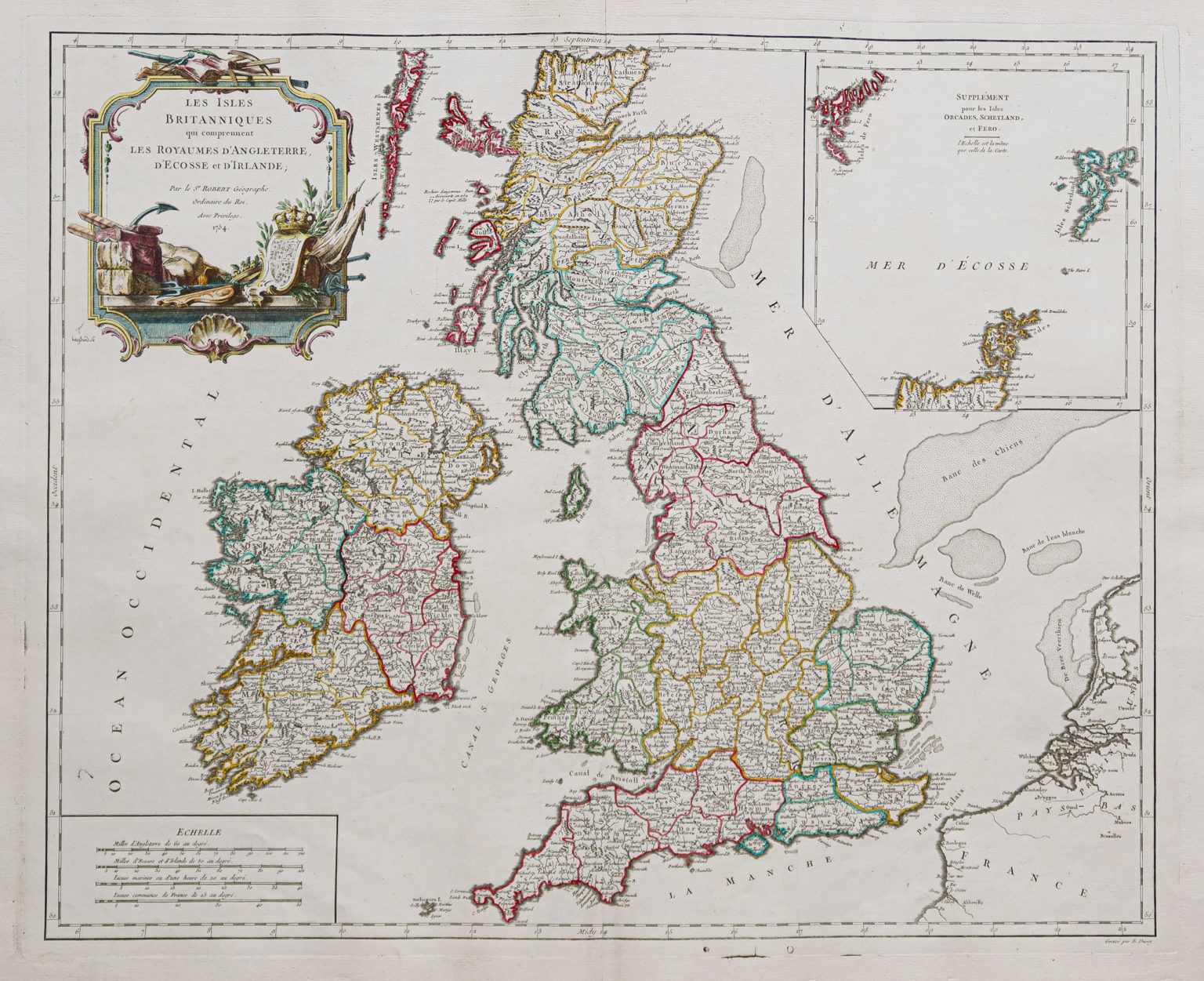
Gregorian chant, or monodic chant, is without doubt the pillar upon which the first traces of written music in the West were conceived. For centuries, the art of plainsong developed throughout Europe, each region having its own style. In the British Isles, the taste for polyphony developed very early, while on the continent musicians kept to plainsong.
From the very beginning of the 12th century in Britain, music was already being sung essentially in two parts, and it is even said that in Wales they sing with as many parts as there are singers. If the earliest attempts at polyphony, probably influenced by Icelandic and Irish traditions, were based on the use of parallel 4ths and 5ths, very quickly the inhabitants of the British Isles whom had come from Scandinavia (Danes and Norwegians) brought an unusual change: they had a particular taste for “imperfect” consonances—3rds and 6ths—an aspect that would mark English style forever.
This tradition does not seem to have arisen from an intellectual compositional exercise, but rather from the practice of improvisation. British musicians had the gift of being able to sing in several parts over a given melody. It is therefore this tradition that would determine the music written later: to give one example, one may say that the improvisation of the gymel (twin chant) influenced the birth of the conductus. This writing in two parts gained a third from the 13th century onwards. Thus was born the famous English discantus, which would mark not only composition within the British Isles, but also the musical writing of the continent: this musical form would give birth to the famous fauxbourdon, a more structured and systematic adaptation of the art of the English discantus.
Thus, Leonel Powerand John Dunstable represent the apogee of English contrapuntal writing at the beginning of the 15th century. Dunstable was particularly renowned in the musical circles of his time: the composer, also a mathematician and astronomer, in the service of the Duke of Bedford, probably travelled to France and even spent time in the country, since the Duke was appointed Regent of France during the years 1420, then governor in Normandy. This music enormously influenced Gilles de Bins (known as Binchois) and Guillaume Dufay, the two greatest composers of the Burgundian court, heirs to the art of Power and Dunstable.
The beautiful three-part polyphonic songs of these famous musicians captivated European ears. The rondeaux of poets such as Charles d’Orléans and Christine de Pizan (among others) were set to music by these two geniuses, in English contrapuntal style.
Comet Musicke traces the origin of this popular practice: improvised polyphonic singing, based on the use of the third and the sixth, so characteristic of the “contenance angloise”, an art which stood in opposition to the somewhat “harsh” colour of French music of the 13th and 14th centuries.
Through ancient examples as well as the art of improvisation, the musicians will illustrate the path of the medieval masters of the British Isles. This varied programme will show the musical trajectory of English music, which gave birth to sweet consonances, a taste that progressively spread throughout Europe, profoundly and forever changing the history of Western music.
Performers
Francisco Mañalich – tenor & vielle
Aude-Marie Piloz – vielle
Sarah Lefeuvre – soprano & recorders
François Joron – baritone
Cyrille Lerouge – alto
Cyrille Métivier – vielle & cornett