
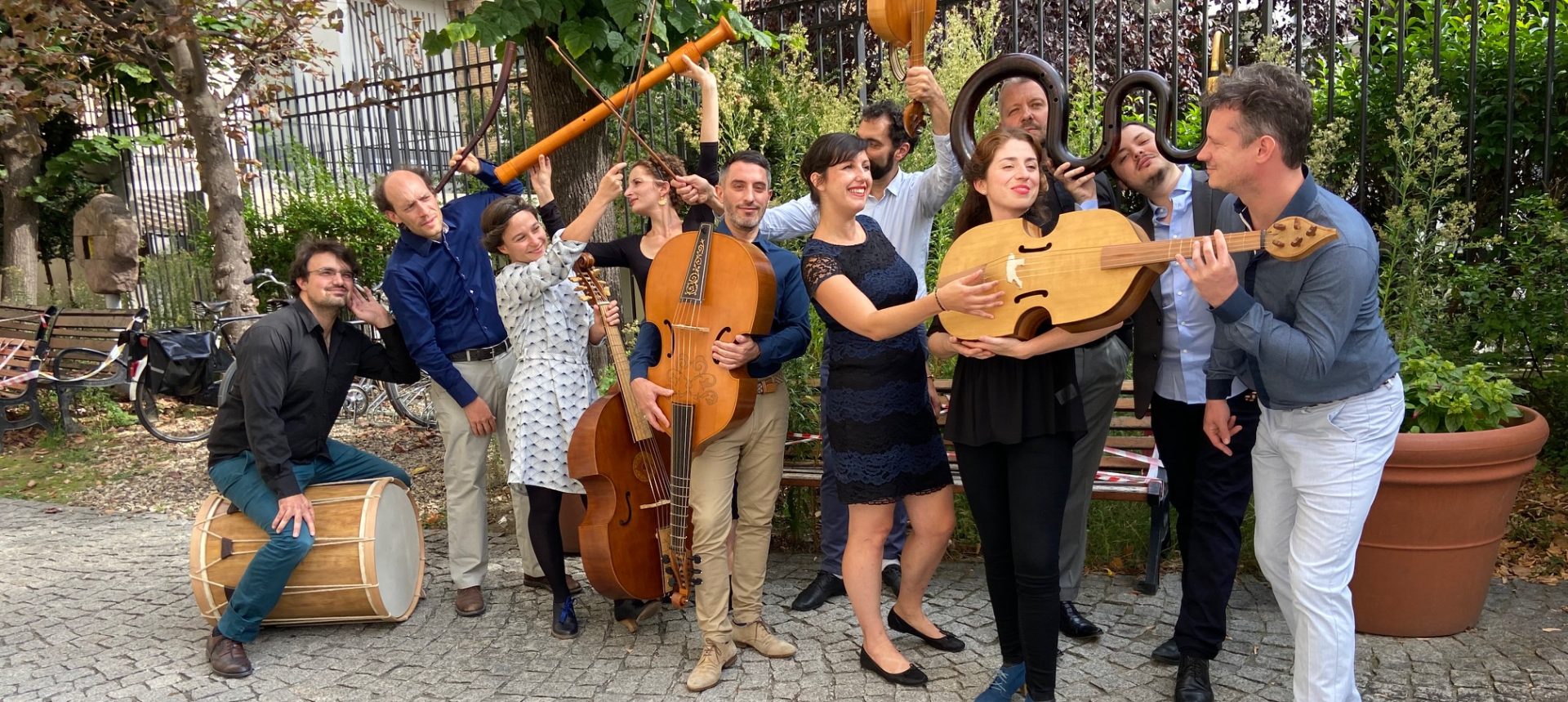
Press
Prize of the Deutschen Schallplattenkritik 2026 (Alte Musik) – Bettina Winkler (original German version below)
(original version)
“Pomponio Nenna steht heute meist im Schatten seines Zeitgenossen und Kollegen Carlo Gesualdo. Beide haben sich gegenseitig beeinflusst in Sachen Textgestaltung, Dissonanzen und chromatischer Modulationen. Das Ensemble Comet Musicke, bekannt für seine intensive Forschungsarbeit, hat Nennas erstes Madrigalbuch von 1582 aufgenommen. Damit macht es den Weg frei für die Wiederentdeckung dieses italienischen Renaissance-Komponisten. Die kongeniale, stilsichere Interpretation mit ihrem ausdrucksstarken Klang fesselt sofort, das Zuhören wird zum Genuss!”
5 DIAPASONS : Pomponio Nenna, Premier Livre de madrigaux à cinq voix. And pieces by Trabaci and Macque – September 2026, Diapason / Denis Morrier
His Primo Libro of 1582 is dedicated to his patron, Fabrizio Carafa, Duke of Andria, who would meet a tragic fate eight years later: he was murdered with his mistress, Maria d’Avalos, on the orders of the cuckolded husband, one Gesualdo! A disturbing detail: Nenna then entered the service of the murderer, vying with him in the exploration of the durezze and other stravaganze. His renown proved equally enduring. In 1643, Marco Scacchi saw in his ‘table’ madrigals (‘da tavolino’), intended for discerning amateurs, the apogee of the Stylus cubilucaris (or ‘chamber’ style).
If modern performers have regularly slipped pieces by Nenna into their Gesualdo-centred programmes, the benchmark recording was still a long time coming. Coming after the rather unconvincing four-voice Primo Libro by the Palazzo Incantato (Tactus, Trois Diapason), it goes without saying that great things were expected of Comet Musicke, an ensemble of eleven musicians in which multi-instrumentalists and singers sometimes turn their hand to the recorder or the viola da gamba.
The distribution of the polyphonic parts is constantly renewed, from a cappella with one voice per part to the most varied ‘broken consorts’, varying the colours as the verses unfold, as in Gigli, rose e viole. For the imposing Sommo Rettor del giorno, the sopranos are gathered on a single desk, supported by eloquent instrumental writing. Often, as in E ch’entro il carro, the consort of viols sets aside the bow in favour of pizzicatos.
A few well-chosen instrumental pages introduce two familiars of Gesualdo and Nenna: Trabaci (with a learned triple fugue) and Giovanni de Macque (whose vertiginous Consonanze stravaganti are as staggering in their harmonic daring as in their fearsome ornamentation).”
EXCEPTIONAL: Comet Musicke shines in “Il primo libro de madrigali” by Pomponio Nenna – 02/06/2026, Scherzo.es / Urko Sangroniz (original Spanish version below)
(original version)
“Pomponio Nenna formó parte de la corriente madrigalista del sur de Italia que tuvo en Nápoles su centro neurálgico. Como el resto de sus coetáneos meridionales, empleó el cromatismo y la disonancia expresiva, la acusada emoción y el dramatismo al servicio de la retórica musical, dibujando líneas melódicas para subrayar palabras o metáforas concretas. Il primo libro de madrigali, publicado en Venecia en 1582, evidencia el estilo y los recursos apuntados de forma incipiente, menos evidente que en su Quarto libro, el siguiente que de él se conserva. Esta primera aportación al género está dedicada a Fabrizio Carafa, Duque de Andria y Conde de Ruvo —también patrón de Nenna— y al alumbramiento de su retoño Antonio. El carácter laudatorio de la colección ensalza las virtudes de Carafa, junto a otros sentimientos como el amor, la pasión y la alegría. El destino de su dedicatario, a quien Gesualdo asesinó junto a su propia esposa al descubrir el adulterio y la relación que mantenían, sería mucho más funesto. Imbuídos del espíritu y la energía de estas deliciosas composiciones, tan floridas y expresivas como interesantes en su desarrollo del estilo imitativo, el magnífico conjunto Comet Musicke demuestra su calidad individual y grupal con un bello sonido, muy empastado y vigoroso, en unas elocuentes lecturas. La variedad de acompañamientos de la sección instrumental, doblando o sustituyendo a las voces con coherencia y en relación a lo que el texto expresa, es admirable. Los cordófonos frotan, puntean o golpean las cuerdas sin reparo en función de los afectos expresados, interrumpiendo su labor por momentos para aumentar la tensión. Las excelentes interpolaciones instrumentales a cargo del conjunto de violas da gamba, con obras de Giovanni de Macque y Giovanni Maria Trabaci, sorprenden por su innovación.”
A TRUE GEM! COMET MUSICKE revives the first madrigals of Pomponio Nenna – 18/08/2026, ResMusica / Cécile Glaenzer
A native of Bari, in Apulia, the knight Pomponio Nenna belongs to that generation of gentleman composers whose most celebrated member is Carlo Gesualdo. Nenna’s biography crosses that of the Prince of Venosa: his first patron, Fabrizio Carafa, Duke of Andria, was none other than the lover of Gesualdo’s wife — a wife whom Gesualdo would have put to death a few years later, together with her lover. But before that drama, Nenna’s Premier Livre de madrigaux à 5 voix celebrates the birth of Carafa’s eldest son, a happy occasion that prompted music of a joyful, luminous cast, with spirited rhythms. After Carafa’s tragic death, Nenna settled in Naples at Gesualdo’s court, with whom he would share a close stylistic affinity in the art of the stravaganza. The Premier Livre, however, still belongs to the world of lightness and pastoral inspiration, even if the darker side surfaces from time to time, in chromaticisms and dissonances that seem to anticipate the rest of the story.
The ensemble Comet Musicke here brings together eleven musicians and singers, many of them multi-instrumentalists in the manner of their artistic director Francisco Mañalich, himself a tenor and viol player, who takes up the vihuela here. This original way of blending voices and instruments is the ensemble’s hallmark, and here it varies the distribution of these five-voice madrigals, from a cappella versions to those in which the viols play colla parte, so as to vary the colours. A few instrumental pieces by Giovanni de Macque and Trabaci judiciously punctuate the programme — transcriptions of organ works played here by the consort of viols. One finds refined counterpoint and the chromaticisms typical of Gesualdo’s circle. The expressiveness of the dissonances that pervade the whole programme throws into relief the contrasts bound up with the meaning of the text, between descriptions of nature in festive vein and the first stirrings of amorous torment. Comet Musicke once again demonstrates its eloquence, in a limpid polyphony as though sculpted from the supple, shimmering substance of a highly homogeneous sound. A true gem.“
CD: Pomponio Nenna, Il primo libro di madrigali, Ricercar, Pomponio Nenna bittet zum Tanz – 25/04/2026, Online Merker / Dirk Schauß (original German version below)
The album revolves around a very concrete joyful event: the birth of the ducal heir Antonio Carafa. In Nenna’s writing here, the bonfires of the Neapolitan alleys and the pealing of Andria’s bells seem to spring straight from the notes. A euphoric sonority prevails that one would hardly have credited to this composer, who later, as Gesualdo’s closest companion, descended into the abysses of dissonance. What still reigns is pure sonic delight that caresses the ear rather than challenging it with experimental harshness.
Under the direction of Francisco Mañalich, the musicians capture the idiom of these works with astonishing assurance. In the spacious, breathing sound the voices merge into a living organism without losing their individual presence. Myriam Arbouz and Sarah Lefeuvre lead the soprano registers with a clarity that never turns shrill but nestles around the middle ranges like fine silk thread. In the polyphony every phrase remains audible: every imitation, every playful interjection of the tenors or the bass can be followed precisely. It is a shared breathing that makes the architecture of the madrigals seem elastic and alive.
Particularly successful is the embedding of the instrumental interludes. Organ works by Giovanni de Macque and Giovanni Maria Trabaci, transferred to a consort of viols and vihuelas, gain an entirely new, warm colouring. A wonderful island of calm is the eleventh track on the CD: the “Consonanze stravaganti”. Here the viols unfold a spectrum of overtones that almost makes one forget that these melodies were originally conceived for the keyboard. A meditative density arises that lets the listener drop out of time for one precious moment.
Of course, in Nenna a premonition of what was to come always resonates. Anyone who reads the texts closely discovers the first delicate shadows amid the descriptions of flowers and herbs. In madrigals such as “D’ogni ben casso e privo” the frictions multiply, lamenting a fate deemed worse than death. Here already that Neapolitan style announces itself which, a little later, was to shake the musical world. The historical irony remains piquant: Nenna’s patron Fabrizio Carafa was that unfortunate man whom Gesualdo surprised in the marriage bed years later and murdered. Nenna himself then promptly entered the service of the murderer. On this CD, however, the tragedy remains a distant, barely audible echo.
With this recording Comet Musicke achieves the rare feat of undertaking a journey through time into the past that at the same time feels fascinatingly present. The rhythms are playful, the melodies flow with an ease that recalls the finest moments of Luca Marenzio. No didactic history lesson is intended here, but rather the sheer joy of life of a young Apulian cavalier who paints his world in the brightest of colours. Anyone who wishes to experience how Naples sounded before the shadows lengthened will find an absolute jewel here – a stylistically assured, sensual pleasure for all who love the madrigal as a living experience.”
(original version)
“Bevor Carlo Gesualdo die Harmonik sprengte, gab es in Süditalien eine Epoche der Unschuld und des strahlenden Lichts. Im Zentrum dieser Wiederentdeckung steht Pomponio Nenna, 1556 in Bari geboren. Sein „Primo Libro de Madrigali“ von 1582 ist keine schwermütige Beichte, sondern ein sinnliches Fest – und das Ensemble Comet Musicke erweckt es mit Eleganz und Frische zum Leben, wie man sie in der Alten Musik nicht oft findet. Nenna sah sich zeitlebens als Edelmann, als Cavaliere, und genau diese noble Leichtigkeit durchzieht jede Note dieser Aufnahme.
Das Album kreist um ein ganz konkretes freudiges Ereignis: die Geburt des herzoglichen Stammhalters Antonio Carafa. Wenn Nenna hier komponiert, scheinen die Freudenfeuer der neapolitanischen Gassen und das Geläut der Glocken von Andria unmittelbar aus den Noten zu entspringen. Es herrscht eine euphorische Klanglichkeit, die man diesem Komponisten, der später als engster Weggefährte Gesualdos in die Abgründe der Dissonanz hinabstieg, kaum zugetraut hätte. Noch regiert die reine klangliche Wohltat, die das Ohr umschmeichelt, statt es mit experimentellen Schärfen zu fordern.
Unter der Leitung von Francisco Mañalich treffen die Musiker den Tonfall dieser Werke mit verblüffender Sicherheit. Im weiträumigen, atmenden Klang verschmelzen die Stimmen zu einem lebendigen Organismus, ohne ihre individuelle Präsenz zu verlieren. Myriam Arbouz und Sarah Lefeuvre führen die Sopranregister mit einer Klarheit, die nie scharf wird, sondern sich wie feiner Seidenzwirn um die mittleren Lagen schmiegt. In der Polyphonie bleibt jede Phrase durchhörbar: jede Imitation, jeder spielerische Einwurf der Tenöre oder des Basses lässt sich präzise verfolgen. Es ist ein gemeinsames Atmen, das die Architektur der Madrigale elastisch und lebendig erscheinen lässt.
Besonders gelungen ist die Einbettung instrumentaler Zwischenspiele. Orgelwerke von Giovanni de Macque und Giovanni Maria Trabaci, übertragen auf ein Consort aus Violen und Vihuelas, gewinnen eine völlig neue, warme Farbigkeit. Ein wunderbarer Ruhepol ist das elfte Stück der CD: die „Consonanze stravaganti“. Die Gamben entfalten hier ein Spektrum an Obertönen, das beinahe vergessen lässt, dass diese Melodien ursprünglich für die Tastatur gedacht waren. Es entsteht eine meditative Dichte, die den Hörer für einen kostbaren Moment aus der Zeit fallen lässt.
Natürlich schwingt bei Nenna immer schon die Vorahnung des Kommenden mit. Wer die Texte genau liest, entdeckt zwischen den Schilderungen von Blumen und Kräutern die ersten feinen Schatten. In Madrigalen wie „D’ogni ben casso e privo“ mehren sich die Reibungen, wird ein Schicksal beklagt, das schlimmer sei als der Tod. Hier kündigt sich bereits jener neapolitanische Stil an, der wenig später die Musikwelt erschüttern sollte. Die historische Ironie bleibt pikant: Nennas Gönner Fabrizio Carafa war jener Unglückliche, den Gesualdo Jahre später im Ehebett überraschte und ermordete. Nenna selbst trat danach kurzerhand in den Dienst des Mörders. Auf dieser CD aber bleibt die Tragödie noch ein fernes, kaum hörbares Echo.
Comet Musicke gelingt mit dieser Aufnahme das seltene Kunststück, eine Zeitreise in die Vergangenheit zu unternehmen, die zugleich faszinierend gegenwärtig wirkt. Die Rhythmen sind verspielt, die Melodien fließen mit einer Selbstverständlichkeit, die an die schönsten Momente Luca Marenzios erinnert. Hier will keine belehrende Historie erklingen, sondern die pure Lebensfreude eines jungen apulischen Kavaliers, der seine Welt noch in den hellsten Farben malt. Wer erfahren möchte, wie Neapel klang, bevor die Schatten länger wurden, findet hier ein absolutes Juwel – einen stilsicheren, sinnlichen Genuss für alle, die das Madrigal als lebendiges Erlebnis lieben.”
Pomponio Nenna “Il Primo Libro de Madrigali” by Comet Musicke on the Ricercar label. SUBLIME! – 27/04/2026, Stretto, Magazine voor kunst / Michel Dutrieue (original Dutch version below)
Not to be missed!“
(original version)
“Pomponio Nenna werd in 1556 in Bari geboren en studeerde daar bij Stefano Felis. Vervolgens verhuisde hij naar Napels, waar hij in een stimulerende geest van wedijver zijn carrière als componist begon. Nenna en Carlo Gesualdo beïnvloedden elkaars madrigaalstijl in hun behandeling van tekst, dissonantie en chromatische modulatie. Nenna’s vocale werken worden hier aangevuld met een aantal orgelwerken van lokale componisten zoals Giovanni Maria Trabaci en Giovanni di Macque, die hier bewerkt zijn voor een ensemble van vihuela de arco en gamba’s.
Niet te missen!“
Hymns in Quechua, an Indigenous Baroque Composer to be Discovered at the Festival – 26/05/2026, Mittelbayerische Zeitung / Claudia Böckel (original German version below)
An indigenous Baroque composer to be discovered at the festival
Regensburg. The Tagen Alter Musik take us on a journey to the four corners of the world! Music from the most distant regions reaches Ratisbon (Regensburg), where one discovers a Baroque-era composer who belonged to an indigenous Andean family of nobles and musicians, and who succeeded in creating music in South America even in the colonial period.
The Apumayta family is in evidence throughout almost the entire 18th century in Cusco, the “navel of the world” of the ancient Inca Empire, in present-day Peru, but also in the territories corresponding to today’s Bolivia and Colombia.
The ensemble Comet Musicke, based in France, is directed by Francisco Mañalich, a tenor and gambist born in Chile. He devises innovative programmes, “musical biographies in concert”, and projects combining research with various artistic forms. He sometimes even sings and plays at the same time, while directing the ensemble with simple movements of his head.
The concert opened in the Dominicans’ church with a Gregorian chant. Three women performed the chant Veni sponsa Christi in the middle of the nave. Explanatory texts, accompanied by a little improvisation, allowed the audience to discover the South American Baroque music of Francisca Apumayta.
Francisca’s father was maestro de capilla (chapel master) in several places. He taught his two children counterpoint and the singing of psalms. His daughter became a composer, a music teacher and a lay sister at the convent of the Poor Clares of Cochabamba.
The concert brought to life a veritable kaleidoscope of South American music. It ranged from hymns in the Quechua language, performed with great spirit by the singers accompanied by cornett, violin, cello and viol, to liturgical compositions, notably the two masses “of the maestra Apumayta”, particularly solemn in character, rich in sonority and of remarkable virtuosity.
At certain moments these compositions seem unusual, even hardly conforming to European musical logic. They nevertheless remain ever innovative and extremely interesting.
The concert thus connected different spheres: European traditions and the culture of the indigenous peoples as well as that of the Spaniards; Cusco and the more isolated city of Cochabamba; secular life and monastic life; and, finally, the freshness of a young generation of remarkably well-trained singers and instrumentalists at the service of early music.”
(original version)
“Hymnen auf Quechua Beim Festival gab es eine indigene Barockkomponistin zu entdecken Von Claudia Böckel Regensburg. Wo man überall hinkommt bei den Tagen Alter Musik! Musik aus den entferntesten Ecken der Welt kommt nach Regensburg, man lernt eine Komponistin der Barockzeitkennen,dieeinerindigenen Anden-Adels- und MusikerfamilieangehörteundinSüdamerika auch zu Kolonialzeiten Musikproduzierenkonnte.Fastdas ganze 18. Jahrhundert hindurch ist diese Familie Apumayta in Cusco, dem „Nabel der Welt“ des alten Inka-Reiches, im heutigen Peru gelegen, aber auch im Gebiet des heutigen Bolivien und Kolumbien nachweisbar. Das Ensemble Comet Musicke, in Frankreich beheimatet, wird geleitet von Francisco Manalich, einem aus Chile gebürtigen Tenor und Gambisten, der innovative Programme, Konzert-Biografien und Kombinationen verschiedener Künste mit Forschung konzipiert. Er selbst singt und spielt auch schon mal gleichzeitig, leitet das Ensemble mit Kopfbewegungen. In der Dominikanerkirche gingeslosmitGregorianischem Choral. Drei Frauen sangen in der Mitte des Kirchenschiffs „Komm Braut Christi“. Texte, unterlegt mit ein wenig Improvisation, halfen, die südamerikanische Barockmusik von Francesca Apumayta kennenzulernen. Apumaytas Vater war maestro di capilla an verschiedenen Orten, lehrte seine beiden Kinder Kontrapunkt und Psalmen zu singen. Die Tochter wurde Komponistin, Musiklehrerin und Laienschwester im Konvent der Armen Klarissinnen in Cochabamba. Ein Kaleidoskop südamerikanischer Musik wird im Konzert heraufbeschworen, es geht von Hymnen in Quechua-Sprache, sehr temperamentvoll mit Gesang, Zink, Violine und Viola da Gamba in Szene gesetzt, bis zu den liturgischen Kompositionen, den beiden Messen „de la maestra Apumayta“, die sehr feierlich, klangintensiv und virtuos daherkommen. An manchen Stellen wirken die Kompositionen ungewöhnlich, nicht ganz logisch aus europäischer Sicht, aber immer innovativ und höchst interessant. Verschiedene Sphären wurden hier verbunden, europäische Traditionen mit der Kultur der Indigenen und der Spanier, Cusco und das abgelegenere Cochabamba, säkulares und klösterliches Leben, frische Gesangs- und Instrumentalkultur von jungen, bestens ausgebildeten Musikern und Musikerinnen mit Alter Musik.”
The Three Marys open the Early Music Festival – 19/06/2023, Dernières Nouvelles d’Alsace / Bernard Fruhinsholz
After providing a musical welcome on the esplanade of Dusenbach Abbey with a few melodies by Claudio Monteverdi, the members of the ensemble Comet Musicke, directed by the singer and gambist Francisco Mañalich, celebrated, in the intimacy of the chapel, the “Three Marys“, as Alnitak, Alnilam and Mintaka – the three stars that form the heart of the constellation of Orion and the three brightest stars in the sky – are known in the Hispano-American imagination. The three Marys, namely Mary, the mother of Jesus, Mary Magdalene and Mary of Bethany, whom religious painters show united at the foot of the cross.
Poeticising the approach
While many of their peers string the pieces of their programme together without a break, Comet Musicke alternates them with short literary excerpts, not in order to explain the approach but to poeticise it, to put words to ideas and to allow each listener to fashion his or her own narrative, to weave his or her own legend. One such excerpt came from Marguerite Yourcenar’s “Marie-Madeleine ou le salut”, in which the author has the sinner (Mary Magdalene) declare: “From the moment the demons left me, I became the one possessed by God.”
Centuries mingle
A teeming body of material, entire swathes of which still remain to be discovered, so-called early music (or medieval, even Baroque) lends itself readily to the building of thematic encyclopaedias. No purist will object if centuries mingle and interpenetrate, if the last note of a piece by Merula serves as a springboard for a chant composed five centuries earlier by Hildegard von Bingen… Nor will anyone be troubled to see a stylish instrumental sextet (violas da gamba, flute, violins, cornett) turn in an instant into an equally accomplished vocal group, a cappella!
John Dowland, Girolamo Frescobaldi, Marc-Antoine Charpentier and Henri Dumont numbered among the architects of this “Ceinture d’Orion”, but two young contemporary composers in their thirties, Christopher Gibert and Francisco Alvarado, burst into this ever-moving brotherhood, the former by “revisiting” a work by Claudio Monteverdi, the latter by working in the spirit of Henry Purcell… and rousing the audience’s enthusiasm!”
ORFEO – COMET MUSICKE, a moment of grace – 13/03/2023, BaroquiadeS / Pierre Benveniste
As a curtain-raiser, Yu Nakamura played two pieces masterfully, by Tarquinio Merula (1595-1665) and Girolamo Frescobaldi (1583-1643), on the fine organ of the church, built in 2007 by Dominique Thomas.
The performance that followed comprised the following parts: the happiness of Orfeo and Euridice following their wedding, the death of Euridice and Orfeo’s despair, the death of Orfeo. The musical flow was punctuated by the declamation of works by poets of Graeco-Roman antiquity (Apollonius of Rhodes, Ovid, Virgil, …). In a few words, here is the story of the Thracian poet as told by Ovid in Book X of the Metamorphoses: “To free Euridice from the Underworld, Orfeo calms the fierce beasts that guard the abode of the dead, makes the stones weep and charms Hades and Persephone. He is granted Euridice on condition that he does not turn his gaze back… Just as he believes Euridice is free and the surface of the Earth is close at hand, he turns round to verify that his wife is still following him, but she disappears from his sight.” Orpheus is caught up by his fate; this time the death of Eurydice is final. Deaf to the entreaties of the Maenads, the poet is torn to pieces by them. According to Friedrich Schiller (1759-1805), “blind submission to fate is always humiliating and insulting to a man in love with freedom, determined to depend only on himself” (a phrase quoted by Helmut Wirth for a performance of Orfeo ed Euridice by Joseph Haydn).
By turns singers and storytellers, the artists have a very rich instrumentarium at their disposal: six-string violas da gamba, vielles, lira da braccio, cornett. They sing while accompanying themselves on their instruments. The vielle, ancestor of the violin, was fitted with a neck, a fingerboard and five strings at the end of the Middle Ages. The manner of tuning the instrument has varied over the ages. According to the Dominican Jerome of Moravia (c. 1240-c. 1304), it was advisable to stretch the strings so as to obtain the following notes, from low to high: D, G, G, D, D, producing intervals of fifths and octaves and making it possible to play in all the modes. The vielle does not have the brilliance of the violin but a soft, warm sound that marries admirably with that of the violas da gamba and the voices. The lira da braccio resembles the vielle. It is larger, with seven strings, two of which are not played and serve as drones. The bridge is flat, which allows playing in chords. Although these instruments were in steep decline at the beginning of the seventeenth century, their presence in this ensemble was perfectly justified by the wonderful euphony produced by the combination of the singers’ voices and the instruments.
Francisco Mañalich (who also directs the ensemble) is a remarkable singer. This tenor’s voice has superb projection and is very even across the different registers of his range; the timbre is warm and richly coloured; the highly harmonious legato is ideally suited to such expressive music. He is also a fine gambist, as can be appreciated in the pieces in which he accompanies himself. His qualities came through clearly in Sigismondo d’India’s heart-rending lamento, Piangono al pianger mio le fere e i sassi, and in Possente spirto, taken from Monteverdi’s Orfeo, in which the vielles engage in echo imitations. These airs followed a first part that opened with the famous Sinfonia introducing Monteverdi’s Orfeo, in which Cyrille Métivier performed a beautiful improvisation on the cornett. There followed two instrumental pieces drawn from madrigals: O felici occhi miei by Jacopo Arcadelt and Diego Ortiz, and O Morte by Cipriano Da Rore, which gave the instrumentalists, Cyrille Métivier on the vielle and Camille Rancière on the lira da braccio, the opportunity to show the full extent of their talent. Aude-Marie Piloz delighted the audience with her agile, elegant playing on the bass viol and her art of diminution. The four artists joined their voices in an excerpt from Luigi Rossi’s Orfeo, Ah piangete, ah lagrimate, accompanying themselves on their instruments of choice, as well as in the chorus of the Maenads in fury taken from Stefano Landi’s Orfeo.
To thank the enthusiastic audience, the mischievous artists offered, by way of an encore, an excerpt from Orphée aux enfers by Jacques Offenbach.
Everything in this concert deserved praise: the versatility of the artists, the intensity of their commitment, the originality of the conception and execution of the programme, and a relatively broad yet beautifully unified panorama of composers active in the first quarter of the seventeenth century. The four musicians enabled the privileged few present in the church to experience a moment of grace. Thanks to such talents and to the power of the myth, Orpheus has never ceased to fascinate music lovers and composers, from time immemorial to the present day.”
5 stars (“Excelente“) | Diego Ortiz, Caleidoscopio – COMET MUSICKE – 6/04/2022, La Revista de Música Clásica / Àngel Villagrasa Pérez (original Spanish version below)
The double album we present here contains highly varied music by Diego Ortiz, including four works that had never been recorded before. Short anonymous pieces and works by Antonio de Cabezón, Juan del Encina and Francisco Guerrero, among others, complement this monographic programme. The works on both discs are absolutely varied, which makes it impossible for the listener to be bored.
The ensemble Comet Musicke gives us a magnificent performance, making use of different instrumentations in each of the works, which allows us to appreciate the particular sonorities of the different Renaissance instruments such as the viola da gamba, the vihuela, the serpent, the bajón, the lira and the percussion, all combined with the voices. The result is a novel reading of Diego Ortiz’s work, different from what we are accustomed to hearing. It is a matter of ‘re-instrumenting’ these works by applying historical performance criteria, which offers us that ‘kaleidoscope’ that gives the album its title. The performers appear well integrated, with good musicianship and a command of the style. The booklet is well documented, including the sung texts as well as a fragment of the facsimile of the Alma redemptoris mater and of Diego Ortiz’s Tratado de Glosas, so that one can see what the musical notation of that period looked like. The most demanding listener will miss the specification of the tuning and temperament used by the performers, as well as the place and dates of recording – details that are increasingly specified on recordings. Despite this small detail, this is a highly recommended recording that could be the perfect introduction to the music of Diego Ortiz.”
(original version)
“Diego Ortiz fue uno de los compositores más importantes del Renacimiento español, no solo por su excelente música, sino también por su famoso Tratado de glosas que, aún hoy día, sigue siendo una de las fuentes musicológicas más importantes en los criterios de ornamentación de este tipo de música.
El doble disco que presentamos contiene música muy variada de Diego Ortiz, incluyendo cuatro obras que hasta el momento no se habían grabado nunca. Pequeñas obras anónimas, de Antonio de Cabezón, Juan del Encina o Francisco Guerrero, entre otros, sirven para complementar este programa monográfico. Las obras de ambos discos son absolutamente variadas, cosa que hace imposible que el oyente se aburra.
El grupo Comet Musicke nos ofrece una interpretación magnífica, haciendo uso de diferentes instrumentaciones en cada una de las obras, cosa que nos permite apreciar las sonoridades concretas de diferentes instrumentos del Renacimiento como la viola da gamba, la vihuela, el serpentón, el bajón, la lira o las percusiones, todo ello sumado a las voces. El resultado es una lectura novedosa de la obra de Diego Ortiz, diferente de la que estamos acostumbrados a escuchar. Se trata de ‘reinstrumentar’ estas obras, aplicando criterios históricos interpretativos, cosa que nos ofrece ese ‘caleidoscopio’ que da título al disco. Los intérpretes se muestran bien cohesionados, con buena musicalidad y dominio del estilo. El libreto está bien documentado, con la inclusión de los textos cantados, así como un fragmento del facsímil del Alma redemptoris mater y del Tratado de Glosas de Diego Ortiz para poder comprobar cómo era la escritura musical de esa época. El oyente más exigente echará en falta la especificación de la afinación y temperamento que usan los intérpretes, así como el lugar y fechas de grabación, datos que cada vez más se suelen especificar en las grabaciones. A pesar de este pequeño detalle, se trata de una grabación muy recomendable que puede ser la introducción perfecta para conocer la música de Diego Ortiz.”
A Cross-Portrait of the Instrumental and Liturgical Repertoire of Diego Ortiz – 4/02/2022, Crescendo Magazine / Christophe Steyne
Bringing together the instrumental art of Diego Ortiz (the 1553 Trattato de Glosas) and the liturgical repertoire of his Musices Liber Primus (1565) makes it possible to ‘build a kaleidoscope that reveals a sonic portrait’ of this Chapel Master to the Viceroy of Spain, in the words of Camille Rancière. The Recercadas have been well served on record: in a post-medievalist vein one recalls the excursions of Atrium Musicae under Gregorio Paniagua (Harmonia Mundi, July 1977), but above all one thinks of the successes of Jordi Savall in April 1989 on Astrée, or more recently Bruno Cocset on Alpha. The sacred side, however, remains to be explored, as with the Marian programme (Ad Vesperas) of Cantar Lontano conducted by Marco Mencoboni (SACD Alpha, 2006). The ensemble Comet Musicke has here pored over facsimiles from Bologna and offers us a handful of motets announced as previously unrecorded: a sumptuous Alma redemptoris Mater draped in viols, Regina celi letare alleluia, Sancta et immaculata virginitas, Benedicta es celorum Regina. After a first album devoted to Gilles Binchois and Johannes Ockeghem, Francisco Mañalich’s team now arrives with this stimulating mixed programme, which also invites other contemporaries of the Hispanic sphere.
The first CD of this double album takes its inspiration from the chanson Doulce mémoire popularised by Pierre Sandrin (c1490-1560), the second (‘Felices Ojos’) from the influence of the gaze and of the Felici occhi miei of Jacques Arcadelt (1507-1568). This diptych thus sets in perspective the original airs and their treatment by variation and gloss, adorned with those ‘diminutions’ typical of the period. Not short on audacity (the Recercada Primera for bow, entrusted… to the serpent, which also makes itself heard in the Sesta), the instrumentarium is renewed from one piece to the next — plucked strings, for example, for Cabezón’s Pavana con su glosa, followed by an Ay de mi qu’en tierra ajena that showcases serpent and cornett, the latter weaving itself around the recorder in Recercada Quinta. The swagger of a Cavalier de Spagna or of a ¿Por qué rrasón fuistes de Ruysellón? punctuated by the drum contrasts with the hushed moments. Viols and vihuelas de arco naturally hold pride of place in the polyphonic texture. The accompaniment is woven into the vocal pages, in keeping with the preface to the Venetian collection of 1565.
One is almost surprised that such a composite anthology — where the Earth borders on Heaven — and a sometimes motley realisation should flow with such evident ease: the dance succeeding pious song, invention mingling with archaism. Through the humility and spontaneity of their approach, these versatile, gifted musicians move the listener without ostentation or dogma. The voices are not the most strongly characterised, but they are sincere and alive. A warm, convivial rapport emerges, enlivened by a generous recording made in the church of Chambray in the Eure. All credit to Comet Musicke and to the Breton label that recorded it: a welcome addition to the discography of the Toledan!”
Caleidoscopio – Diego Ortiz (4 Diapasons), Motets and Recercadas. Comet Musicke, Son An Ero (2 CD) – March 2022, Diapason / Guillaume Bunel
After an album devoted to the songs of G. Binchois and J. Ockeghem (cf. no. 688), the young ensemble deploys a rich palette of voices, bowed strings, early brass, recorders and percussion; varied and often felicitous combinations (viols in pizzicato and mute cornett; viol arco, serpent and recorder) contribute to bringing out the best of each composition.
Compared with the Recercadas of Jordi Savall, which set the benchmark in 1990 (Astrée/Alia Vox), those of Comet Musicke display an invigorating vivacity, imagination and precision destined to make their mark.”
Diego Ortiz, or the art of glossing and of singing with the ensemble Comet Musicke – 29/12/2021, ResMusica / Frédéric Muñoz
Diego Ortiz is one of the most important musical figures of the Spanish Renaissance. He remains famous for his celebrated Trattado de glosas, published in Rome in 1555. It is a method for learning the art of the gloss, or diminution, that is to say the manner of filling in the long note values of a polyphony, through a particular technique of passing notes. This treatise remains a reference, extended in its second part by a whole series of pieces entitled Recercadas (Researches), in which the author puts into practice the theoretical principles of the first part of the work. Particularly intended for the viola da gamba, it is clear that these works can be played on other instruments, especially all those that make up the accompaniment of the solo viol. It is precisely this card that the ensemble Comet Musicke, led by Francisco Mañalich, chooses to play. Eleven musicians gathered together for this album offer their adaptations modelled on the practices of the time. We are thus presented with a selection of twelve instrumental pieces from the twenty-seven that the treatise contains. Several of them draw on themes already in existence, borrowed from other composers, including Doulce memoire by Pierre Sandrin (1490 ca-1560) and O felici occhi miei by Jacques Arcadelt (1507-1568). This allows the vocal music to be interwoven into this programme, in which the original madrigals are presented alongside the pieces glossed by Ortiz.
The other music book by Diego Ortiz, published in Venice in 1565, is the Musices Liber Primus, which this album allows us to get to know more fully. We may even rejoice that some motets from this collection are recorded here as world premieres. One notices how deeply the composer drank from the various musical currents of his time — from Flanders, France and Italy — to which were added those proper to Spain. He juggles harmoniously between ornamentation, rhythms and that precise way of blending the voices with the instruments. Everything serves to make a sometimes austere polyphony radiate, embellishing it in a refined manner. So this album, entitled Caleidoscopio, lives up to its name, logically bringing together the sacred and the profane, the voice and the instrument, in a skilful construction. The Motets of D. Ortiz remain a summit of Renaissance vocal art, to which Spain made an essential contribution, his compositions having made him chapel master to the Viceroy of Naples. His celebrity was such that he may be found on the great canvas of the Wedding at Cana, conversing with the painter Veronese himself.
A recording of the most natural kind captures the vocal works admirably in the Renaissance church of Chambray (Eure), in an informed and warm-hearted interpretation. The beauty of the voices reveals to the highest degree the superiority of the musical texts — of those motets whose inspiration is to be sought in Josquin and Ockeghem, of whom Ortiz himself said they were ‘true doctors of music’. To perfect this summit meeting between the author’s two collections, Comet Musicke offers a few pieces contemporary with Ortiz, as if to immerse his art in the air of his own time, to which each one adds his stone: one thinks of Cabezón father and son, Guerrero or Patavino with the theme of La Spagna, taken up by Ortiz. There is at once great intimacy in this music and a dazzling projection, characteristic of this Iberian art made of contrasts, of shadows and of light. Following on from the productions of Jordi Savall (Alia Vox) and Marco Mencoboni (Alpha), this new approach takes its place among the finest references devoted to this composer, of whom we have surely not finished discovering further secrets.”
CD: Discovering the Music of Diego Ortiz (technical rating 5/5) – 17/01/2022, ON-Mag.fr / Jean-Pierre Robert
Diego Ortiz (ca. 1510-ca. 1570), apparently born in Toledo, settled in Naples in the 1550s, where he became chapel master to the viceroy. He travelled throughout Europe, notably to Rome, where in 1553 he published a treatise on instrumental practice, the Trattado de Glosas (Treatise on Glosses). It is, in the words of Frédéric Muñoz, ‘a method concerning a particular manner of ornamenting a musical text’. The treatise also contains pieces written on themes or melodies then in vogue, whether madrigals or instrumental works called Recercadas. In Venice, in 1565, Ortiz published another work, the Musices Liber Primus, composed of motets for 4 to 7 voices on plainsong themes. Unlike the first, well known to specialists, this second work has fallen into oblivion.
The ensemble Comet Musicke thus defines the purpose of the present album: ‘with a group made up of voices and melodic instruments, we sought to build a kaleidoscope revealing a sonic portrait of Diego Ortiz, assembling pieces of diverse nature organised around his Recercadas and his Motets, while placing these works back in their context’. The programme is thus composed of two thematic parts, subtitled ‘Douce mémoire’ and then ‘Yeux heureux’, and mingles the profane with the sacred, the serious with the joyful. It pairs works by Diego Ortiz with those of others such as Antonio de Cabezón, Jacques Arcadelt or Francisco Guerrero. The extremely original instrumentation calls on unusual instruments, such as the serpent, the bowed vielle, the cornett or castanets.
Among the Motets of Diego Ortiz, drawn from the Musices Liber Primus, one hears in particular a Salve Regina misericordia alternating a cappella and accompanied singing, of rare fervour. Or an Alma redemptoris Mater in which the alto voice over a consort of violas da gamba precedes a second section associating tenor, alto and bass. Ortiz wrote several versions of one and the same work, as is the case with the Benedicta es caelorum Regina, given here first for seven voices, then for five. This song of praise has a different duration as regards its two verses in either case.
As for the secular pieces, the tune Douce mémoire, a recurring theme of the Renaissance in Europe, sung by Ortiz in the piece, in Old French, Doulce mémoire en plaisir consummée, is placed in perspective with compositions by his contemporaries. Such is the case of Francisco Millán (active at the beginning of the 16th century) in Dulce y triste memoria. The allusive subject of the ‘Yeux heureux’ inspires Francisco Guerrero (1528-1599) with his madrigal Yeux clairs et sereins, from which emanates real tenderness, Rodrigo de Ceballos (ca.1525-1581) with Yeux magnifiques, amoureux, profonds, of a sweet affliction, and also Jacques Arcadelt (1507-1568) with the piece O felici occhi miei.
As for the Recercadas of Diego Ortiz, they are, like the Italian ricercari, free instrumental pieces cultivating repetition. Here they bring the counterpoint to the fore in a luxuriance of writing detail for one or more violas da gamba, or in an astonishing flute-cornett dialogue (Recercada Quinta sobre tenor italiano). Or again a serpent and a bowed vielle (Recercada Sesta). It is interesting to compare them with other pieces, by Antonio de Cabezón, for example, a celebrated organist (1510-1566). Thus the Pavana con su glosa, delicately paced on the vielle, or that piece Diferencias sobre la Pavana Italiana, a sort of variations, perhaps more graceful.
All this music, once championed by Jordi Savall, is here performed with conviction by the musicians of Comet Musicke. Most of them are versatile — singers and instrumentalists alike — in the image of their artistic director Francisco Mañalich, himself a tenor and a viol player. Besides the aptness of the sequences, one is won over by the luminosity of the voices, the gentleness of the intonations and the quality of the playing on these instruments typical of the 16th century that are the serpent (a low wind instrument in the shape of an S), the cornett or the bowed vielle (a string instrument). One experiences a feeling of plenitude on listening to this anthology of the music of Diego Ortiz and his contemporaries.
The recording, made in the church of Saint-Martin at Chambray in the Eure, does them justice through a skilful spatialisation of the voices according to the pieces and an intimate capture of the instruments, all of undeniable presence.”
Diego Ortiz, Caleidoscopio – Ensemble Comet Musicke, 2 CDs Son An Ero – 11/11/2021, Valeurs Actuelles / L. L.
GUEMAR: A MUSICAL BIOGRAPHY – 1/10/2021, Dernières Nouvelles d’Alsace / Bernard Fruhinsholz
A Spanish gambist and composer who set off to seek his fortune at the court of the King of Naples, Diego Ortiz (c. 1510 – c. 1570) was the most celebrated gambist of his century but was also an important theorist and pedagogue, publishing notably in 1553 a treatise (Tratado de glosas) codifying ornamentation for his instrument of choice but also for the recorder, the violin, the cornett and several others, in the accompaniment of voices as well as for purely instrumental pieces. The programme proposed by the ensemble directed by Francisco Mañalich makes these rules explicit. To open this performance, sponsored by the Friends of the Ribeauvillé Organ, the organist Henry Webb played three short pieces by Francisco Correa de Arauxo (1554–1654), highlighting the finely nuanced registration of the Callinet organ in the church of Saint-Léger.
A concert alternating purely instrumental pieces with accompanied vocal works (for two, three, four or even seven voices), often preceded by short declaimed texts, lending the whole the air of a musical biography of a composer and violist who was also a renowned man-at-arms; the works of Ortiz rubbing shoulders with those of some of his contemporaries who composed chansons. Throughout all these pieces runs a constant that owes much to the precision of the treatise governing their performance but which, without the human factor (that is to say the sensitivity of the interpreter), would have little meaning, rather like a great chef’s recipe in the kitchen of a drudge!
Communicative emotion!
To the indispensable musical qualities, the ten members of Comet Musicke have added — the fruit of an almost symbiotic cohabitation with the chosen works — a communicative sensitivity, a rare sense of nuance, able individually to highlight an instrumental or vocal trait before blending back into the collective, emotion (communicative) in particular in the Recercada settima sobre tenor, giving full meaning to the word ‘polyphony’, notably with the motet Regina celi by Ortiz or Un cavalier di Spagna by Francesco Patavino… going so far as to stage certain vocal parts in the space (nave and side aisles) the better to share them. Given as an encore, an unpublished piece sung by the ten members of Comet Musicke gathered in a circle (highly elliptical!) in the central aisle was followed by a thoroughly deserved standing ovation.
TO NOTE: All of the Diego Ortiz pieces played and sung during this concert (and many more besides) were recorded a few months ago by the ensemble Comet Musicke; the double CD Diego Ortiz – Caleidoscopio is available from Son an ero at the price of €20.”
THE MYTH OF ORPHEUS REVISITED WITH BRIO BY COMET MUSICKE AT SIMIANE-LA-ROTONDE – 8/08/2021, ResMusica / Cécile Glaenzer
For the 39th edition of its early music festival, Simiane-la-Rotonde chose to offer a journey around the figure of Orpheus, tutelary figure of music. Comet Musicke invites us to travel through the Italy of the early Baroque, in a programme in four tableaux: a portrait of Orpheus, his encounter with Eurydice, the death of the beloved and the return from the Underworld. To link each episode of the story, each musician in turn becomes a narrator, reading texts by Ovid and his contemporaries, reminding us that the imitation of antiquity was an ideal for every Renaissance artist. Just as the poet accompanied himself on his lyre, so here the bowed strings of the viols and vielles improvise a subtle accompaniment to the texts being read, with oriental accents reaching back towards the Bulgarian origins of the myth. Instrumental music by Lappi, Banchieri, Bonizzi and Rossi alternates with opera airs by Landi, Peri, Cavalli and, of course, the Orfeo of Claudio Monteverdi.
One of Comet Musicke’s particularities is the great variety of its instrumentarium. For this programme, an unusual consort performs the instrumental pieces: two violas da gamba for the lower parts and two vielles for the trebles. It works very well, with a fine homogeneity, and sounds perfectly in the beautiful acoustics of the medieval rotunda of Simiane. Here, the closeness to the audience is further reinforced by the disposition of the viols played standing up, at the height of the spectators: one thus has the impression of being at the heart of the consort. And it is the instrumentalists themselves who turn singers for the vocal pieces in three or four parts. The central role of Orpheus is held by the excellent tenor Francisco Mañalich, with his powerful, well-timbred voice, who also accompanies himself on the viola da gamba. From Monteverdi, the opening Toccata of Orfeo allows the first appearance of Cyrille Métivier’s cornett (he also plays the vielle): the four musicians fill the acoustics as if they were three times as numerous. Small forces, great effect! (to paraphrase the impression we had when we first heard this remarkable ensemble at the Radio France Occitanie Montpellier festival, in a memorable programme).
Two instrumental pieces showcase the virtuosity of the strings: Ortiz’s diminutions on the lira da braccio over a chanson by Arcadelt, and Bonizzi’s on a theme by Cipriano da Rore, on the bass viol played by Aude-Marie Piloz. The aria Possente spirto from Monteverdi’s Orfeo allows us to appreciate the celebrated echo effects realised here on the vielles. The aria Tempro la cetra by Monteverdi brings this programme to a delicate conclusion.
And to finish, a humorous encore highlights the ensemble’s eclecticism: a pastiche of an aria for Pluto from Offenbach’s Orphée aux Enfers joyfully brings this exceptional evening to a close.
(Simiane-la-Rotonde. 5 August 2021. Works by Pietro Lappi (1575–1630), Stefano Landi (1587–1639), Francesco Cavalli (1602–1676), Claudio Monteverdi (1567–1643), Solomoni Rossi (1570–1630), Francesco Rasi (1574–1621), Diego Ortiz (1510–1570), Vincenzo Bonizzi (?–1630), Jacopo Peri (1561–1633). Ensemble Comet Musicke: Aude-Marie Piloz, viola da gamba; Cyrille Métivier, vielle and cornett; Camille Rancière, lira da braccio and vielle; Francisco Mañalich, tenor, viola da gamba and artistic direction)”
Chansons of Binchois, Ockeghem and Desprez (5 stars) – October 2020, Classica / Nicolas Boiffin
This constant renewal, not only between chansons but also from one stanza to the next, is all the more remarkable in that it follows no system whatsoever: each piece is enhanced by its own particular lighting. The vast programme laid out across the two discs, in which one encounters Ockeghem’s Mort tu as navré de ton dart as well as chansons little or never recorded, opens the door to a lively musical journey, full of surprises. Already versed in numerous musical styles, the ensemble formed by Francisco Mañalich in 2017 distinguishes itself here with a highly original first opus, which a disc devoted to the music of Diego Ortiz should soon follow.
“ QUINZE ” by the ensemble Comet Musicke : Binchois and Ockeghem as a duo – Magical – April 2020, ResMusica / Charlotte Saulneron
It matters little whether we are witnessing the genesis of an ensemble of singers and instrumentalists whose versatility had been particularly noted at the Radio France festival in Montpellier the year before: everything is here to charm. First, the pleasant impression of an ambitious project from the moment the object is in hand: a handsome two-disc box set, a clear and readable theme for a generous musical programme (18 tracks on the first CD and 12 on the second), an accompanying booklet that plays its role without faltering…
Then, in-depth musicological research, essential when approaching the early music repertoire (here from the end of the Middle Ages to the dawn of the Renaissance), born of the research of the ensemble’s artistic director, Francisco Mañalich, who specialises in Binchois’s three-part chansons (c. 1400–1460) and then naturally extends to those of Johannes Ockeghem (c. 1410–1497). The stylistic characteristics of the two composers are clearly presented in Raphaël Picazos’s short but effective booklet note, from the melodic turns and rhythmic discourse of the Burgundian master to his influence on the work of Johannes Ockeghem, who would dedicate his Mort tu as navré de ton dart, performed on this recording, to him upon Binchois’s death.
Then, an unprecedented interpretative vision that the ‘historically informed’ approach does not divert from music’s primary vocation: to please. The freshness of this approach is characterised by the variety of the instrumentation, Comet Musicke having chosen to vary sonorities and colours by opting for a different instrumental line-up for virtually every piece. The musicological approach is very much present, since the goal is to ‘reflect the organological developments of this period’, but for our contemporary ear it produces a constant renewal of listening, making this succession of vocal and instrumental pieces seductive while also demonstrating, as the listening progresses, the delicacy of each protagonist’s commitment. Likewise for the text, the rigorous reconstruction of fifteenth-century pronunciation diffuses a refined atmosphere, supported by clear diction and limpid prosody.
Finally, musical discoveries that will satisfy connoisseurs, this album perfectly completing a discography at once specialised and eclectic. Ultimately, this is a thoughtful and audacious project that perfectly testifies to the great quality of these performers. Magical.”
CD: “Quinze”, a secular portrait of the fifteenth century (technical rating 5/5) – 5/05/2020, ON-TopAudio.fr / Jean-Pierre Robert
Medieval music has been enjoying a revival of interest of late. The Comet Musicke ensemble sets side by side two major musicians of the period: Gilles de Bins, known as Binchois, and Johannes Ockeghem — both of whom cultivated the art of song and its favourite theme, that of courtly love: the beauty of woman, the changing faces of love and the torments of separation, from desire to sorrow, from elation to disappointment, even to the pain of the beloved’s absence. Yet they do so in very different ways. Gilles Binchois (c. 1400-1460), master of the Burgundian chanson, offers graceful, fluid and effortless melodic turns, inherited from the Ars Nova of the fourteenth century, with lightly irregular rhythms and a learned counterpoint, in short phrases punctuated by cadences. Was he not nicknamed the ‘Père de joyeuseté’! The chanson can indeed be joyful, as in ‘Mon cœur chante joyeusement’, with its bright, infectious tone. He is equally witty: as in ‘Filles à marier ne vous mariez jamais’, a humorous text rendered by the various timbre combinations of the eight parts. The following piece, ‘Si je soupire, me plains et pleure’, provides a contrast, being the gentle, resigned lament of one who acknowledges ‘Je ne pensais pas voir l’heure où il me faudrait aimer autre que lui’. One finds astonishing dissonances there at times. Some pieces open with a softly spoken form of declamation over a light accompaniment, before the vocal consort takes up the text once more: as in ‘Bien que Danger, Médisance et leurs gens’. A few purely instrumental pieces are skilfully interwoven among the chansons, either prolonging the mood or providing a genuine break.
The chansons of Johannes Ockeghem (c. 1410-1497) are set in a more melancholic vein. So it is with ‘J’en ai chagrin que je n’en suis morte’ and its introduction by a lively cornett figure, which then goes on to converse with the baritone. The song-motet in nine parts, and of vast dimensions, ‘Mort, tu as blessé de ton trait’, was written by the composer as a homage to Binchois. He unfolds within it a gentle lament charged with fervour, at first contained, then expanding. The varied singing of the vocal consort is punctuated by a brief instrumental ritornello. Regret mingles with eulogy, as in a requiem prayer. Ockeghem also pays musical tribute to his master by using some of his devices, such as the fauxbourdon texture so cherished by Binchois in his own chansons. The instrumental pieces are just as interesting, in particular one entitled ‘Prenez sur moi votre exemple amoureux’, for two violas da gamba and the vielle. One also hears two works by Josquin des Prez (c. 1450-1521), including one in homage to Ockeghem, ‘Nymphes des bois, déesses des fontaines’, a motet for five voices combining Jean Molinet’s poem ‘Nimphes des bois’ with the Gregorian Introit antiphon Requiem aeternam.
Founded in 2008 by the tenor, gambist and vielle player Francisco Mañalich, the Comet Musicke ensemble and its nine musicians ‘play’ these chansons, several of which have never before been recorded, with a genuine concern for authenticity, drawing strength from the most recent research into how they should be performed — notably by speaking the texts in Old French and revealing all their idiosyncrasies of intonation, colour and delivery. They likewise restore the lyricism of the poetic word and the shimmer of the musical parts through various voice-instrument combinations. In all of them one admires the vocal sweetness and the expressiveness of the instruments, always on the lookout for the right nuance. This is a veritable kaleidoscope of colours and rhythms, of refinement and melodic tenderness, in a manner that is never heavy-handed, for it always stays within an intimate register. All these outstanding musicians deserve to be named: Aude-Marie Piloz, vielle and Renaissance viola da gamba; Marie Favier, mezzo-soprano; François Joron, baritone; Sarah Lefeuvre, soprano and recorders; Cyrille Métivier, countertenor, cornett, vielle and recorder; Camille Rancière, vielle and baritone; Daniela Maltrain, vielle, Renaissance viola da gamba and recorder. And, of course, Francisco Mañalich, tenor, vielle and Renaissance viola da gamba, who also provides the artistic direction. Trained on the gamba, among other things, by Christophe Coin, and in singing by Anna Maria Panzarella, he already has to his credit the famous production of Le Bourgeois gentilhomme directed by Denis Podalydès, and performances alongside Leonardo García Alarcón and with the Compagnie La Tempête. Hats off to them all!
The recordings, made at the Espace Sainte-Anne in Lannion under the post-production supervision of three of the musicians, offer a very carefully studied balance between voices and instruments and a studied spatialisation, from which emanates a genuine feeling of intimacy. The sonic picture is as pleasing as the performances are captivating.”
QUINZE (4 Diapasons), Polyphonic chansons by Binchois, Ockeghem, Josquin Desprez. Comet Musicke, Francisco Mañalich. Son An Ero (2 CDs) – March 2020, Diapason / J. M.
Nine performers share out seven voices (soprano, mezzo, countertenor, tenor, three baritones) and a dozen vielles, viols, cornett and recorders. The many combinations of forces serve a rich palette of sonorities, from the majestic instrumental choir of Mort tu as navré de ton dart (in Ockeghem) to the delicate pizzicatos supporting the narrator in Quoy que Dangier Male Bouche et leur gent (in Binchois).
The energetic vocalism and the splendour of the instruments stamp the chansons with an engaging musicality. Borrowed from Josquin, Baisés moy ma doulce amye and Nimphes des bois show that the young collective knows how to convince without artifice.”
QUINZE: Binchois and Ockeghem, Ensemble Comet Musicke, 2 CDs Son An Ero – 13/02/2020, Valeurs Actuelles / L. L.
“QUINZE”: Binchois and Ockeghem by Comet Musicke (Son An Ero) – RECORD OF THE WEEK – 10/02/2020, Concertclassic.com / Alain Cochard
Crowned at the Sinfonia Festival in 2017 in the context of its ‘Jeunes Talents’ series — always a discerning pick — Comet Musicke made a strong impression last year at the Festival Radio France Occitanie Montpellier. With formidable stage presence, the musicians do not stop at playing a vast repertoire, from the Middle Ages to the early Baroque; they literally bring it back to life. Six centuries separate us from the works of Gilles de Bins, known as Binchois (c. 1400-1460), a musician who very early on enjoyed real recognition (he was active at the Court of Burgundy from the late 1420s). But with Comet Musicke, the compositions of the man nicknamed the ‘Père de joyeuseté’ are not historical curiosities to be admired on a museum shelf: they are music revived and made fully tangible by the investment and artistry of performers who define it as a ‘secular portrait of the fifteenth century borne by fifteen voices and instruments’. The instruments are assigned an essential role by Mañalich and his team; mingled with the vocal timbres, they bring irreplaceable warmth and relief to scores celebrating woman, desire and the love of the fair lady.
In the same interpretive frame of mind, and no less convincing, the second disc brings together nine chansons by Johannes Ockeghem (c. 1410-1497), a musician marked by the art of Binchois, whose death inspired him to write a moving lament (“Mort tu as navré de ton dart”). Josquin des Prez (c. 1440-1521) is among those who brought music into the era of the Renaissance. He admired Ockeghem, a ‘true treasurer of music’, whose death he sorrowfully sang in ‘Nimphes des bois déesses des fontaines’, a piece that admirably closes a precious album, carefully produced by Son an Ero.
As for Comet Musicke’s upcoming concerts, we shall have to wait until the summer to see the ensemble again, but there will then be no lack of opportunities to gauge its repertoire and its talent.
BEST OF 2019, Recording | QUINZE. COMET MUSICKE. Son an Ero – 27/12/2019, Codalario.com / Fabiana Sans (original Spanish version below)
(original version)
“Sorpresa para nuestros oídos ha sido toparnos con el último trabajo discográfico de este ensemble francés, dirigido por Francisco Mañalich. Esta joven agrupación nos trae un doble CD, algo bastante insólito en los tiempos que corren, dedicado a dos grandes figuras de finales de la Edad Media como son Johannes Ockeghem y Gilles Binchois. El detalle y la sutileza con la que abordan este complejo repertorio, así como la calidad y calidez del sonido, los hace merecedores de esta mención.”
MELOMANO DE ORO | QUINZE – COMET MUSICKE – 6/09/2019, La Revista de Música Clásica / Lucía Martín-Maestro Verbo (original Spanish version below)
We are faced with a work that evinces the most absolute historical rigour, yet without falling into the aseptic, into that lack of emotion from which this kind of performance sometimes suffers. For its part, Comet offers an approach to the repertoire that is as “historicista” (in the best sense of the word) as it is passionate and, above all, communicative. Indeed, one of the axioms on which this ensemble builds its work is the need of the twenty-first-century listener for a current and attractive product, principles that are made manifest in this disc.
Quinze is a work that is distinguished by its tireless pursuit of detail and stands out for the remarkably varied palette of colours and sounds it offers from the repertoire. In each chanson Comet builds an entire microcosm, playing with an instrumentation that practically varies from piece to piece, thus providing a sonic richness that will delight the most demanding listener.
Another of the most notable strengths of this double disc is the care with which the texts are treated, whether sung or declaimed, the painstaking reconstruction of the fifteenth-century pronunciation, its intelligibility, as well as the highly refined diction of the language.
We cannot fail to mention the delicate balance of the sound, as well as the exquisite treatment of the musica ficta, satisfactorily unexpected at times. The unquestionable quality of the musicians who make up the ensemble – almost all of them outstanding multi-instrumentalists with considerable experience in historical performance – is made apparent in the refined command of the language that is manifest in the final result of this magnificent recording.”
(original version)
“Liderado por el musicólogo, tenor y violista chileno Francisco Mañalich, Comet Musicke nos presenta un trabajo discográfico de gran ambición: Quinze. Se trata de un doble disco compacto que aborda la obra de dos de las figuras más emblemáticas de ese interesantísimo periodo en términos musicales que se debate entre el final del medioevo y los albores del renacimiento: Gilles de Binchoir y Johannes Ockeghem, indiscutibles maestros de la chanson flamenca del siglo XV.
Nos encontramos ante un trabajo que evidencia el más absoluto rigor histórico, aunque sin caer en lo aséptico, en esa falta de emoción de la que adolecen, en ocasiones, este tipo de interpretaciones. Por su parte, Comet ofrece un enfoque del repertorio tan «historicista» (en el mejor sentido de la palabra) como apasionado y, sobre todo, comunicativo. Y es que uno de los axiomas sobre los que este ensemble construye su trabajo es la necesidad del oyente del siglo XXI de un producto actual y atrayente, principios que se hacen patentes en este disco.
Quinze es un trabajo que se distingue por la búsqueda incansable del detalle y destaca por la variadísima paleta de colores y sonidos que nos ofrecen del repertorio. Comet construye en cada chanson todo un microcosmos, jugando con una instrumentación que prácticamente varía de pieza en pieza, aportando así una riqueza sonora que hará las delicias del oyente más exigente.
Otra de las fortalezas más reseñables de este doble disco es la pulcritud con la que son tratados los textos, bien sean cantados o declamados, y la cuidada reconstrucción de la pronunciación del siglo XV, su inteligibilidad, así como la dicción tan refinada del idioma.
No podemos dejar de mencionar el delicado balance en el sonido, así como el exquisito tratamiento de la música ficta, satisfactoriamente inesperado por momentos. La incuestionable calidad de los músicos que conforman el ensamble, casi todos destacados multinstrumentistas con un gran bagaje en la interpretación histórica, se hace patente refinado manejo del lenguaje que se manifiesta en el resultado final de este magnífico trabajo discográfico.”
“ QUINZE ” – 16/07/2020, ConcertoNet.com : The Classical Music Network / Jessica Naïm
For this recording, the ensemble has chosen an anthology of fifteenth-century polyphonic songs by Gilles Binchois (c. 1400-1460) and Johannes Ockeghem (c. 1420-1497), seeking to recreate the performance practice of this music as faithfully as possible on the basis of in-depth documentation of the historical context in which the works were born, from the study of iconography (tapestries, miniatures) to the various manuscripts and treatises. This is therefore serious musicological work undertaken by Francisco Mañalich, the artistic director, whose master’s thesis at the Sorbonne dealt precisely with Binchois’s three-part songs (superius, tenor, contratenor). In the many rondeaux and the few ballades of the Burgundian master, since the sung text is rarely taken up in the tenor and contratenor parts, the role and choice of the instruments also had to be considered. The album, the fruit of research that also extends to collaboration with specialists in the making of the instruments, thus appears as a testing ground in which, besides the reconstruction of a pronunciation as close as possible to declamation, the voices are supported by an ever-broader instrumentarium whose combinations – varying sonorities and colours – serve the aim of ‘reflecting the organological developments of that era’ and of creating renewal.
“Quinze”, the title of the ensemble’s first recorded album, refers not only to the fifteenth century but also to the fifteen vocal and instrumental timbres used in the making of this disc. Indeed, the singers and musicians, nine in all, display remarkable versatility and, through this generous box set, offer us a rich musical programme that sketches a ‘secular portrait’ of this fifteenth century, the golden age of the French chanson.
Represented by the great masters of the Franco-Flemish School – Binchois, Dufay, then Ockeghem and Busnois – the courtly chanson enjoyed great favour at the time; it was part of life itself, expressing love, joy and sorrow alike. Famous throughout Europe and adapted for instruments (transcribed for organ, spinet or lute), it accompanied the great festivities and was much appreciated by the great lords, as at the court of Burgundy, where its production was concentrated.
The lineage from Binchois to Ockeghem is ingeniously sustained in the choice of programme, in which a clear coherence shines through. The songs of Binchois, nicknamed the ‘father of joyfulness’, belong to the new style of the era and benefit from the influence of English music (notably that of Dunstable, then settled in Paris), to which we owe the taste for melody, the use of florid vocal ornamentation and borrowings from fauxbourdon with its intervals of thirds and sixths. The same characteristics obtain in sacred music, with the sole difference that instead of the tenor, it is the upper, melodic voice (the superius) that takes precedence in the chanson, which constitutes the hallmark of the new style. The lyricism of the poetic word is here enhanced by the clarity of the singers’ prosody, concerned as they are to restore the pronunciations of the period, even more distinct in the declaimed, un-sung passages. The great sonic quality of these songs with their three-part polyphonic structures, which borrow the simple forms of the rondeau and the ballade inherited from the Ars Nova of the previous century, also emerges from the fine balance between voices and instruments and the highlighting of the timbres, reinforced by the decision, for certain songs, to alternate an exclusively vocal performance with its instrumental version, in which the superius is entrusted to an instrument.
Binchois was recognised as a master in his own lifetime, in particular by Ockeghem, his heir, as it were. Having composed some twenty chansons – whereas some fifty are counted in Binchois’s output – Ockeghem distinguished himself above all in sacred music. The more austere tone of the second-generation Franco-Flemish composer is apparent in the works presented, in particular the large-scale Déploration sur la mort de Gilles Binchois (“Mort tu as navré de ton dart/Miserere”), written in memory of the Burgundian master – drawing on certain elements of his idiom – and adroitly inserted into the programme. In it he unfolds a deep lament in the superius while the tenor and contratenor proclaim the Latin supplication “Miserere pie Jesu Domine, dona ei requiem” (‘Have mercy, pious Lord Jesus, grant him rest’), supported by a contratenor basis sounding long held notes. This motet-chanson, the traditional model of the strophic chanson (here a ballade) to which a sacred text sung by another part is added, was to be taken up by Josquin des Prez (c. 1440-1521) in his moving déploration combining the poem “Nymphes des bois/Déesses des fontaines” with the introit “Requiem æternam”, inspired by Ockeghem’s death, and concluding this album admirably, like a double tribute to two great masters at the dawn of the Renaissance.
Throughout his ‘exploration’, the listener is accompanied by the transcription of the songs into modern French as well as by a most instructive booklet giving valuable keys to understanding the idiom. Guided above all by a concern for authenticity, Comet Musicke succeeds with this album both in restoring a repertory and in offering a particularly successful interpretative vision.”
MONTEVERDI BY COMET MUSICKE: SMALL FORCES, GREAT TALENT – 17/07/2019, ResMusica / Cécile Glaenzer
It was in the Salle Pasteur of the Corum in Montpellier that we discovered their original programme, mixing pieces by Monteverdi and his contemporaries with two premieres by today’s composers.
Comet Musicke’s five musicians break the mould to delightful effect: entering to music by walking through the audience, humorous stage business for a concert-biography that tells us the story of Monteverdi’s life, viols played standing up (resting on a stool)… Above all, they are musicians who are by turns singers, narrators and multi-instrumentalists, moving from one art to another with great naturalness. Punctuating the account of the father of opera’s life, extracts from Monteverdi’s greatest works follow one another with fine coherence. Two contemporary premieres fit perfectly into this programme: a piece by Sylvain Morizet (Dolcissimo Uscignolo) and Christopher Gibert’s Ego flos campi, which echoes Monteverdi’s motet of the same name, in which the musical phrase stretches out between the sustained notes of the viols and the cornett.
The musicians’ versatility allows them to offer the audience shortcuts through operas made of minimalist extracts in which the essentials are preserved. Thus the opening toccata of Monteverdi’s Orfeo is played by four players and makes a great effect. The dialogue from Peri’s L’Euridice, sung with the sole accompaniment of Aude-Marie Piloz’s bass viol, who realises the continuo chords, reminds us that the viol is a polyphonic instrument. The Duo Seraphim from Monteverdi’s Vespers is another moment of emotion: two viols, two violins, two singers (one of whom also plays the viol), and everything is there. Francisco Mañalich’s beautiful tenor voice shows great sensitivity and a very secure technique in the extracts from Orfeo. As for the mezzo-soprano Marie Favier, with her fine stage presence, she knows how to move us in the famous Lamento d’Arianna, unfortunately shortened; and she is particularly overwhelming in the aria Adio Roma from L’Incoronazione di Poppea.
Moving from one instrument to another, singing while accompanying themselves on the viol or the guitar: these five young musicians rely on such a solid technique that they give the impression that all of this is easy to achieve. That is the very summit of the art.
(Montpellier. Festival de Radio France Occitanie Montpellier. Salle Pasteur, le Corum. 16-VII-2019. Works by Claudio Monteverdi (1567-1643), Marco Antonio Ingegneri (1535-1592), Sylvain Morizet (b. 1982), Adriano Banchieri (1568-1634), Jacopo Peri (1561-1633), Orlando di Lasso (1532-1594), Christopher Gibert (b. 1993). Ensemble Comet Musicke: Francisco Mañalich, tenor, viola da gamba and Baroque guitar; Marie Favier, mezzo-soprano and narrator; Aude-Marie Piloz, viola da gamba; Cyrille Métivier, violin and cornett; Camille Rancière, violin, viola and voice)”
COMET MUSICKE – JOHANNES OCKEGHEM, “ VRAY TRÉSORIER DE MUSIQUE ” AT THE VOIX ET ROUTE ROMANE FESTIVAL: DISORIENTING! – 6/09/2020, Geneviève Charras
“Comet Musicke offers the complete set of the twenty three- and four-part chansons of Johannes Ockeghem (1410-1497). This composer from Hainaut enjoyed great renown and his contemporaries called him ‘son and pearl of Music’, ‘flower of musicians’ or ‘Vray trésorier de Musique’.
Sunday 6 September at 5.00 p.m.
Strasbourg, Saint-Pierre-le-Jeune Protestant church
Comet Musicke (France)
‘What’s up, Doc?’ Saint-Pierre-le-Jeune, a subtle setting for this extraordinary ensemble, on an autumn afternoon, an atmosphere gradually takes shape, subtly leading us along the paths of an astonishing, extraordinary composer: a diplomat and a singer, leading a life rich in encounters and political responsibilities, spanning an era in which art mingled with the great decisions of state. Setting course for the main points of the compass: north, south, east, west, bound for a journey through time, judiciously punctuated by interventions, recurring, instructive interludes. Along the way we learn the artistic stakes of the twists and turns of Johannes Ockeghem’s eventful life, a one-man orchestra of so many diplomatic ‘orientations’! The ensemble ‘Comet Musicke’ devotes particular attention to an aesthetic exploration of the ‘concert-biography’ genre, punctuated by erudite and edifying talks on the life of the figure who becomes the driving force of the concert. A musical and vocal portrait of a leading light of fifteenth-century polyphonic art! So on with the concert, piloted by eight artists – singers, viol players, vielle players, a cornettist, a flautist – stories told by mezzo-soprano Marie Favier with mischief and spirit, in a storyteller-performer’s play that grows stronger throughout the recital. A fine vocal and stage performance, spot-on facial expressions, always in character.
A breath passes through this ensemble, rose of the desert sands, a wind of angels hovering over the instrumental and vocal compositions that follow one another naturally, in a rhythm sustained by the illuminating words of the narrator-showmen who introduce the pieces from different levels of the space: away from the original stage, in the pulpit, and so on. Each of them displays an interpreter’s talent blending the art of acting with the art of music. With command of a period instrumentarium reproduced identically, all the better to sound the warmth and sensuality of the compositions, blending the vocal line with poetic phrasing: in the accents, linking pronunciation and narrative, restored as closely as possible to the diction-declamation. Beautiful canons in overlapping layers, ‘mouth’ games, tales of mistresses, picaresque narratives: we delight in the works of this man ‘good, generous, pious, charitable’, whose very voice originally combined everything in great harmony. Someone ‘good’, upright, a ‘doctor of music’, a fine and subtle author of enchanting musical narratives, here conducted with a master’s hand by Francisco Mañalich, tenor and viola da gamba, full of charm and mischief, with a great and beautiful presence. And the Ensemble lets fine rolled ‘r’s ring out with assertive, colourful and variegated accents, like all these rocambolesque, amorous or jealous tales of the life of a composer here very well served by energetic, talented musicians. Served by the acoustics of the magnetic, spellbinding setting of Saint-Pierre-le-Jeune in Strasbourg. A further stage in the ‘Rose des Vents’ programme initiated by Voix et Route Romane and its ingenious artistic director, Denis Lecoq.”
VIAF BAROQUE WEEK : MULTIPLE MONTEVERDIAN DELIGHTS et al. – 19/06/2019, Albert George Storace
It was not just the music which made the evening most enjoyable. It was the rapport established between performers and audience. The programme was prepared and extremely well-researched so different members of the ensemble could pass on very interesting background information about each piece performed, and, very often, these included some very witty remarks.
The music of Monteverdi dominated the programme one which reflected the great versatility of the man who was composer, singer, instrumentalist and expert at sacred and profane works. Also a caring husband and father, he was ordained priest after a spell of widowerhood and was composing opera almost until his death at 76! What a genius! Genius reflected in his work thanks to a selected variety which was superbly projected by Comet Musicke. What they have to their advantage is not only do four of them perform very proficiently on a variety of instruments but four of them are singers with the bulk of solo singing falling on mezzo-soprano Marie Favier and tenor Francisco Mañalich. The former’s only instrument is the best one of all: the voice. Hers is a lovely mellow voice while the latter has that typically Iberian timbre, warm and strong. Both singers sang with impeccably expressive precision. Mañalich also performed on the viola da gamba and baroque guitar. The other gambista was Aude-Marie Piloz, Camille Ranciére (violin, viola, voice) and Cyrille Métivier (corner, violin, voice) were the other members of the ensemble. Music by Ingegneri, Banchieri, Peri, di Lasso and the contemporary composer C. Gibert (whose tribute to Monteverdi based on the latter’s Ego flos campi) was performed. This concert ended up with a well-deserved standing ovation.”
“ The performance, blending music and poetry, suits this ensemble perfectly. With modulation and spirit, without ever forcing their respective arts, the artists displayed a dignified restraint in which facial expressions spoke eloquently of the feelings and emotions distilled with great precision. ” 15/09/2017 L’Alsace
“They move from viola da gamba to violin, from rhythmic guitar to cornett with incredible ease. The instruments thus mastered, and especially the violas da gamba in the spotlight, harmoniously envelop the voices. ” 05/08/2017 L’Yonne
“The Vézelay audience certainly felt this great emotion in the highly sensitive interpretation by the Comet Musicke ensemble. ” 05/08/2017 L’Yonne